
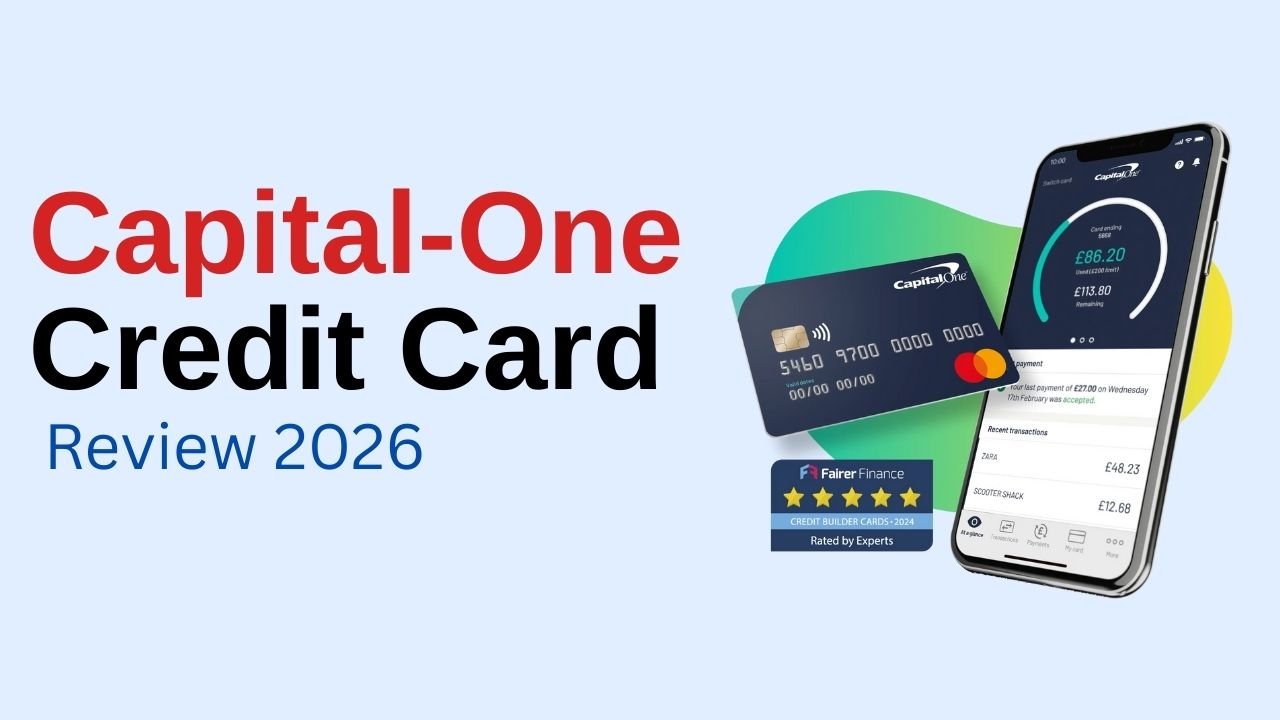
When I first started looking for the best credit card in 2026, I was overwhelmed. There are so many options out there, and everyone seems to have a different opinion. But after using Capital One cards for the past few years and talking to dozens of friends about their experiences, I’ve learned what actually matters.
Let me share everything I know about Capital One credit cards in a way that makes sense, without all the confusing financial jargon.

Why I’m Writing This Review
I’ve personally used three different Capital One cards over the years. I’ve earned cash back, redeemed miles for flights, and yes, I’ve also dealt with their customer service when things went wrong. This isn’t just research from websites, this is real experience mixed with current information to help you make the best decision.
If you’re searching for the USA best credit card that fits your lifestyle, Capital One might be exactly what you need. Or maybe it’s not. Let me help you figure that out.
What Makes Capital One Different?
Here’s what I love about Capital One right away: no foreign transaction fees on any of their cards. I learned this the hard way when I traveled to Mexico with my old bank card and got hit with fees on every single purchase. With Capital One, I’ve traveled to six countries and never paid a penny in foreign fees.
Another thing that stands out is their mobile app. I’m not a tech genius, but their app is so simple that my mom even uses it without calling me for help. You can lock your card instantly if you lose it, check your credit score for free, and even see if you’re spending too much in certain categories.
But Capital One isn’t perfect. I’ve noticed they sometimes give lower credit limits compared to other banks, especially when you first get approved. More on that later.
The Best Capital One Cards (And Who They’re For)
Let me break down the most popular cards in a way that actually makes sense.
Capital One Venture X: The Premium Travel Card
This is Capital One’s fancy card, and honestly, it’s pretty impressive. It costs $395 per year, which sounds like a lot, but hear me out.
When I calculated the value, I realized you get a $300 travel credit every year that you can use on any travel purchase through their portal. You also get 10,000 bonus miles on your card anniversary, which is worth about $100. So right there, you’re almost breaking even on the annual fee.
The coolest part? Access to Capital One lounges at airports. I used one at Dallas Fort Worth last month, and it was like a five-star hotel. Free food, drinks, showers, and comfortable seating. Way better than sitting at the gate eating overpriced airport food.
You earn rewards like this:
- 10x miles on hotels and rental cars through Capital One Travel
- 5x miles on flights through Capital One Travel
- 2x miles on everything else
The card also comes with Priority Pass lounge access, though I should mention that starting in 2026, they’re changing the guest policy. You’ll need to pay for guests, which is a bit disappointing.
Who should get this card? If you travel at least a few times a year and want premium benefits without paying $700+ like the Amex Platinum, this is a solid choice. I’d say you need to spend at least $2,000 a month to make it worth the annual fee.
Capital One Savor: For Food Lovers and Entertainment Fans
This card changed my dining experience, and there’s no annual fee, which is amazing for what you get.
Here’s the breakdown: You earn 8% cash back when you buy tickets through Capital One Entertainment (concerts, sports games, theater), 5% back at certain stores, and 3% cash back on dining, entertainment, streaming services, and groceries.
I eat out a lot—probably more than I should, and this card has earned me over $600 in cash back this year alone. When I go to my favorite Italian restaurant, I’m getting 3% back. When I pay for Netflix and Spotify, another 3% back. It adds up faster than you’d think.
Right now, they’re offering a $300 welcome bonus if you spend $3,000 in the first three months. That’s a limited-time offer, and honestly, it’s one of the best deals I’ve seen for a no-annual-fee card.
The catch? You only get 1% back on everything else, so if you’re buying furniture or electronics, this isn’t your card. But for everyday spending on food and fun, it’s hard to beat.
Capital One Quicksilver: Simple Cash Back
If you hate complicated reward categories and just want something simple, Quicksilver is your answer. You get 1.5% cash back on everything, no exceptions, no rotating categories, no headaches.
I recommended this card to my dad because he doesn’t want to think about which card to use where. He just uses his Quicksilver for everything and earns cash back without any mental effort.
You also get 5% cash back at certain bonus merchants, and there’s currently a welcome bonus where you can earn $300 after spending $3,000 in three months.
The best part? There’s a 0% intro APR for 15 months on purchases. If you’re planning a big purchase and want to pay it off over time without interest, this is incredibly useful. Just make sure you pay it off before those 15 months end, or you’ll start paying interest at rates between 18.99% and 28.99%.
Capital One VentureOne: Travel Without Annual Fees
This is like the younger sibling of the Venture X. You earn 1.25 miles per dollar on every purchase, and there’s no annual fee.
The miles can be transferred to over 15 airline and hotel partners, which means you can sometimes get incredible value. I once transferred miles to Air France and booked a flight to Paris that would have cost me $800, but I used 40,000 miles instead. That’s a value of 2 cents per mile, which is double the baseline value.
If you want to dip your toes into travel rewards without committing to an annual fee, VentureOne is perfect. Plus, you get a 0% intro APR on purchases and balance transfers for 15 months.
Capital One Platinum: For Building Credit
When my younger sister was starting to build her credit from scratch, this was the card she got. There are no rewards, but there’s also no annual fee, and Capital One is known for approving people with fair or limited credit history.
The beauty of this card is that Capital One automatically reviews your account for credit line increases. My sister started with a $300 limit, and within eight months, they increased it to $1,000 without her even asking.
If you’re rebuilding credit or just starting out, this card does exactly what it needs to do: help you build a positive payment history.
Understanding Interest Rates (This Actually Matters)
Let me be honest about something most credit card reviews skip over: interest rates are high, and Capital One is no exception.
Most Capital One cards have variable APRs ranging from about 18.99% to 28.99%. The Venture X is even higher at 20.49% to 29.49%. What does this mean in real terms?
If you carry a $1,000 balance and your APR is 25%, you’re paying about $250 in interest over a year if you only make minimum payments. That $300 welcome bonus? Gone in interest charges.
Here’s my advice from personal experience: never carry a balance on a credit card if you can avoid it. The rewards you earn will never outweigh the interest you pay. I treat my credit cards like debit cards—I only spend what I already have in my bank account.
The one exception is if you use those 0% intro APR offers strategically. If you need to make a large purchase and pay it off in 15 months, that’s a smart move. Just set up automatic payments so you don’t forget.
Fees You Should Know About
Capital One is actually pretty reasonable with fees compared to other banks. Here’s what I’ve learned:
Balance transfer fee: 3% for the first 12-15 months, then 4% after. If you’re transferring a $5,000 balance, that’s $150 upfront. You need to calculate if you’ll save more in interest than you pay in fees.
Late payment fee: Up to $40. I’ve never paid this because I set up autopay, and you should too. There’s no reason to give the bank free money.
Foreign transaction fee: Zero. This is huge. My friend uses a Chase card and pays 3% on every international purchase. On a $2,000 trip, that’s $60 wasted. Capital One doesn’t charge this on any card.
Cash advance fee: 5% or $5, whichever is greater. Never do cash advances if you can avoid it. The interest starts immediately with no grace period.
The Rewards Programs Explained Simply
I’ve used both cash back and miles cards, so let me explain the difference in a way that finally clicked for me.
Cash back is simple: You spend $100, you get $1.50 back with Quicksilver or $3 back with Savor at restaurants. That cash goes into your account and you can use it however you want, statement credit, direct deposit, Amazon purchases, whatever.
Miles are more flexible but require more effort: With miles, you can transfer them to airline partners and sometimes get huge value. But you need to research, understand transfer ratios, and find award availability. It’s not hard, but it’s not automatic either.
Here’s what I do: I use my Savor card for dining and entertainment, and my VentureOne for everything else. Then I transfer those miles once a year when I’m planning a trip. This way, I get the best of both worlds.
One thing I really appreciate: Capital One rewards never expire as long as your account is open. I’ve had banks where points expired after 24 months, and I lost hundreds of dollars in value.
Cool Digital Features That Actually Help
The Capital One mobile app is legitimately one of the best banking apps I’ve used. Everything is where you’d expect it to be, and there are some features I didn’t even know I needed.
Eno is their virtual assistant that creates virtual card numbers. When I’m shopping online at a site I don’t fully trust, I use a virtual card number instead of my real one. If that site gets hacked, my actual card is safe.
CreditWise is completely free and shows you your credit score without affecting it. I check mine every month just to make sure nothing weird is happening. It also gives you tips on how to improve your score.
The Confirm Purchasing Power tool is brilliant. Before you make a large purchase, you can check if it’ll be approved without hurting your credit score. I used this before buying a $3,000 laptop, and it gave me peace of mind.
Getting Approved: What You Need to Know
I’ve helped several friends apply for Capital One cards, and here’s what I’ve learned about approvals.
For cards like the Venture X, Quicksilver, and Savor, you generally need a credit score of 700 or higher. If your score is in the 600s, you might still get approved but with a lower credit limit.
For the Platinum card, people with scores as low as 580 have been approved. Capital One seems more willing than other banks to give people a chance.
Important rule: Capital One typically only approves you for one new card every six months. So if you just got a Quicksilver, don’t apply for a Savor next month. Wait it out.
Also, if you’ve already gotten a welcome bonus from Capital One in the past 48 months, you won’t be eligible for another bonus on the same product. This is why you need to choose your first card carefully.
The application process itself is fast. I’ve been approved in less than 60 seconds before. They’ll ask for your income, housing costs, and Social Security number. Be honest, they verify everything.
What Real Users Are Saying
I’m part of a few credit card communities online, and I’ve noticed consistent patterns in what people say about Capital One.
The good stuff everyone agrees on:
- The approval process is straightforward and quick
- The mobile app is excellent
- No foreign transaction fees is a game-changer
- Customer service is generally helpful and friendly
- Rewards post quickly and are easy to redeem
The complaints I keep hearing:
- Credit limits start lower than other banks (this is my experience too)
- If you need to dispute a charge, the process can be slow
- Interest rates are on the higher end
- Some people have trouble with fraud resolution
In surveys, about 6 out of 10 users rate Capital One 4 or 5 stars. That’s pretty solid, though not perfect.
Capital One vs. The Competition
People always ask me how Capital One compares to other banks. Here’s my honest take:
vs. Chase: Chase has better transfer partners for travel nerds and higher credit limits, but Capital One has better cash back cards with no annual fees and better approval rates for people with average credit.
vs. American Express: Amex has more premium benefits and better customer service, but Capital One is simpler, has no foreign fees, and is accepted everywhere (Amex isn’t always accepted internationally).
vs. Citi: The Citi Double Cash gives 2% back on everything (1% when you buy, 1% when you pay), which beats Quicksilver’s 1.5%. But Capital One’s ecosystem is easier to use, and their app is way better.
vs. Discover: Discover has rotating 5% categories that can be amazing, but you have to remember to activate them and they’re not always useful. Capital One’s fixed categories with Savor are more consistent.
Smart Strategies I’ve Learned
After years of using credit cards, here are strategies that have saved me thousands:
The Two-Card Strategy: I use Savor for dining and entertainment (3% back) and Quicksilver for everything else (1.5% back). This is simple but effective. Some people go crazy with five or six cards, but I find that overwhelming.
Welcome Bonus Planning: Right now, Capital One is offering $300 bonuses on multiple cards. If you know you’re going to spend $3,000 in three months anyway, that’s free money. I timed my Savor application right before the holidays when I knew I’d be buying gifts and hosting dinners.
Balance Transfer Smart Move: My friend had $8,000 in credit card debt at 24% APR. He transferred it to a VentureOne with 0% APR for 15 months and saved over $2,000 in interest by paying it off during that time. Just remember the 3% transfer fee.
Travel Hacking Basics: If you have the Venture X or VentureOne, learn about transfer partners. Transferring miles to Air Canada Aeroplan or Singapore Airlines can get you business class flights for the price of economy. It takes some research, but it’s worth it.
When Capital One Isn’t the Best Choice
I believe in being honest about limitations. Capital One isn’t perfect for everyone.
Skip Capital One if you:
- Need a high credit limit immediately (they tend to start conservative)
- Want business credit cards (their business options are limited)
- Are looking for ultra-premium benefits like the Amex Platinum’s $200 Uber credit and $200 hotel credit
- Specifically want transfer partners like Virgin Atlantic or Marriott that Capital One doesn’t offer
I also think if you have excellent credit (780+) and want the absolute best rewards, you might find slightly better options with other banks. But honestly, for 90% of people, Capital One is more than enough.
Changes Coming in 2026
One thing I’m watching closely: Capital One is changing the Venture X lounge policy in 2026. Right now, you can bring two guests for free. Starting in 2026, you’ll have to pay for guests.
This doesn’t ruin the card, but it’s disappointing. I often bring my wife to the lounge, and now that’ll cost extra. Still, the card’s other benefits keep it valuable.
Also, keep an eye on welcome bonuses. The current $300 offers are limited-time deals. When I got my Savor two years ago, the bonus was only $200, so things do change.
Common Questions I Get Asked
“Do Capital One rewards expire?” No, as long as your account is open and in good standing, your rewards never expire. This is a big deal.
“Can I have multiple Capital One cards?” Yes, but you can only get approved for one every six months, and each card you already have might lower your approval chances for new ones.
“How often do they increase credit limits?” Capital One reviews accounts automatically every six months or so. You can also request increases manually after six months, but I recommend waiting for the automatic increases to avoid hard inquiries.
“What if I’m denied?” Call the reconsideration line at 1-800-625-7866. Sometimes they’ll reverse the decision if you explain your situation. I’ve seen this work multiple times.
My Final Honest Opinion
After using Capital One cards for years and watching friends use them, here’s what I truly believe:
Capital One is the best credit card in 2026 for most everyday Americans. Their cards are simple, the rewards are straightforward, the app is excellent, and there are no foreign fees. For someone who wants good rewards without complexity, you can’t go wrong.
The Venture X is legitimately one of the best premium travel cards available, especially at its price point. If you travel internationally even twice a year, it pays for itself.
The Savor is my personal favorite no-annual-fee card. If you’re a foodie or entertainment lover, nothing beats 3% cash back in those categories with no annual fee.
The Quicksilver is perfect for people who want simplicity. My dad, my uncle, and three of my friends use this, and they all love not having to think about categories.
Are there “better” cards out there for specific niches? Sure. But for the USA best credit card that works for most people, most of the time, Capital One hits the sweet spot.
My rating:
- Rewards Programs: 4.5/5 (excellent value, easy to understand)
- Card Variety: 4/5 (good options but limited business cards)
- Customer Service: 3.5/5 (usually good, sometimes frustrating)
- Fees and Rates: 4/5 (reasonable fees, but high APRs)
- Digital Experience: 4.5/5 (one of the best apps available)
Overall: 4 out of 5 stars
How to Apply (Step by Step)
If you’ve decided Capital One is right for you, here’s exactly what to do:
Step 1: Visit Capital One’s website and check for pre-approval. This doesn’t hurt your credit score. It’ll tell you which cards you’re likely to get approved for.
Step 2: Choose your card carefully. Remember, you can only get one every six months, so pick the one that fits your spending habits best.
Step 3: Gather your information: Social Security number, annual income (include all sources), monthly housing payment, and contact information.
Step 4: Apply online. Most decisions come in less than a minute. If you’re approved, you’ll get your card in 7-10 business days.
Step 5: As soon as you get your card, set up autopay in the app. This protects you from late fees and helps your credit score.
Step 6: Add your card to your phone’s digital wallet (Apple Pay, Google Pay) for extra security.
Final Thoughts
Choosing a credit card shouldn’t be this complicated, but somehow it is. After all my research and personal experience, I keep coming back to Capital One because they make things easy.
You don’t need to be a financial expert to get value from their cards. You don’t need to study complex reward charts or transfer ratios unless you want to. You can just use your card, earn rewards, and get on with your life.
That said, remember this: the best credit card is the one you pay off in full every month. Rewards mean nothing if you’re paying 25% interest on a balance.
Start with one card, use it responsibly, and build from there. Whether it’s the Venture X, Savor, Quicksilver, or even the Platinum for building credit, Capital One has something that’ll work for you.
Good luck with your application, and happy earning!